Sunday, August 2, 2009

Week 5 - teaching and learning in Second Life

I recalled last year when I attended AECT conference, there were a lot of researches exploring the potential applications of Second Life. Second Life seems the most popular virtual world in use today. With its real time/ synchronous characteristics, you can participate in a live event, conference, concerts, etc. Second Life can be use as a means to enhance learning and increase learner motivation. For example use Second Life to create and design situated learning environments, support immersive learning, increase social networking and interaction, and facilitate communication and collaborative learning. In such immersive learning environments, learners can experience real feelings and interaction as they do in a real world and apply knowledge and skills in realistic scenarios. Shy learners are more apt to participate in such attractive learning environments.

The researchers also pointed out some barriers and difficulty. For example, users ( i.e., learners, instructors, instructional designers) may have technological problems or encounter difficulty using the interface of Second Life. Also, it is expensive and time-consuming for instructors or instructional designers to design a virtual world. How to effectively integrate Second Life to support learning and improve performance/ learning is still challenging for instructional designers and instructors.

I also found some wiki websites and blogs about the use of Second Life in education.

Saturday, August 1, 2009

Week 5 prompt

How do issues such as authorship, copyright and open access impact your desire, ability and willingness to engage in produsage, both personally and professionally?

I don't think that copyright and authorship would have a huge impact on my desire or willingness to engage in produsage in my personal or professional field.
What I post in my personal blogs only allows my particular to see, and most of my posts are just my rambling thoughts. I rarely posted something on Twitter and Facebook, so I don't need to worry any copyright issue so much on there. However, the photos I have placed on Flickr and Google Photo have started to get me worried about copyright issues. Because a personal photo that was shared by one of my friends in a photo sharing website was misused and edited without her consent or permission or noticed and had been remixed and re-uploaded to a travel agency website. One friend accidentally went to this website and found this situation. Subsequently the photo was removed from the site after my friend emailed the website and complain the issue. After this thing happened, I still continue upload my photos to the photo sharing websites, but I set the permissions for my photos and only allow my friends and family to access them.

In my professional field, I would very carefully cite and quote all reference materials as I do in writing papers. On the other hand, I also concern the authorship and copyright issue. I can understand and appreciate the danger that lies in the world wide web. It is relatively easy to use photos or online content without permission. It is hardly possible to prevent from every single illegal use or distribution in a virtual environment. I may not be able to check if someone copy my writing or misuse my photos. Hence, my attitude toward online postings is cautious optimism. I will still be encouraged to share my thoughts and views on public forums and blogs but will refrain posting private photos and contents. In addition, I would kindly remind them to be sure to cite the resource and add watermark to protect the images if needed.

Week 5 - a predictive technology

Recently, I read an article " The Web Knows What You Want" from Business Week By Stephen Baker.

Corporates want to know the customer's behaviors for online shopping businesses, so that after a shopper look at/ buy a particular item, the system can appear a recommendation that is precisely what the shopper wants. That's just like a sale clerk could give customers recommendations through observing customer's body language and behaviors in a brick-and-mortar store. This is not a new idea, but they want to adopt a new predictive technology in order to improve the accuracy of recommendations and to earn more money. For example, when I look at or add a camera into my shopping cart at Amazon, it would suggest me to buy related accessories and recommend me what other customers who bought this same item also bought. Every time I log in to my account,Amazon will offer personalized product recommendations to me.

The patterns of clicks, purchases, personal information are analyzed, and many other factors may influence an individual's selection. Also, privacy issues may cause some concern to some online shoppers. However, I have more positive attitudes towards this predictive technology. I'm thinking how time saving this will be and what related terms this will show, if I'm searching information on an online library database. At least from a researcher or a student's point of view, this technology could lead me to dig deeper into more research topics relevant to the field of interest.

Sunday, July 26, 2009

Week 4 CiteULike and delicious

This week, I have tried to play with CiteULike and delicious. Similar to Diigo, Delicious.com and CiteULike are also social bookmarking tools.

I can see the most popular bookmarks on Delicious's home page. Hence, I can see what other people are most interested currently. It's also very convenient to save the links listed on the first page as my personal bookmark. But unlike Diigo, delicious can't add Sticky Notes or highlight information on a web page.

CiteULike doesn't have that annotation features as Diigo, either. But I think one of the advantage of CiteULike is that it has a citation management feature. I can choose different citation formats and see the abstracts of the articles. This is more useful for researchers, who need to collect academic articles, cite reference, and write papers. I can see other people's bookmarks and tags on the CiteULike's home page. Through other people's bookmarks, I can even connect to ERIC database to find more relative articles that I may be interested in. I feel CiteULike will be beneficial for me because of its citation management features and I still need to explose it more.

An introduction to CiteULike, CiteULike: a researcher's social bookmarking service (Emamy & Cameron, in Ariadne) .

Week 4 prompt

How do you judge the value of expertise on the Web? Does it differ from your notion of expertise in face-to-face settings? Why or why not?

Actually, there is no big difference for me to judge the expertise between on the Web and in face-to-face settings. I respect people’s thoughts and comments on the Web and what they say in face-to-face settings, and try to keep my mind open to things that I don’t know or understand.

If there is a new term that I don’t know, I would check several resources that I obtain from Google search. I may go to the more reliable websites to cross-check information. If that is an ordinary, general question, then I may take less time to check and find out the information. Basically, that kind of information just for my personal reference and won’t affect my professional performance; hence, I may not check the authors’ background information.

If I’m looking for something that is related to more professional field, in addition to cross-checking different sources of information, I will need to check authors’ educational background, the amount of experience the authors have in the related area. For example, if I need to cite or quote the information, I would try to seek for the academic articles that have been peer-reviewed and published.

Basically, I have my own standard of judgment and value system, and I think I value the expertise based on my own beliefs and value system , and I keep my judgment consistent no matter on the Web or in face-to-face settings.

Saturday, July 25, 2009

Week 4 -Technorati

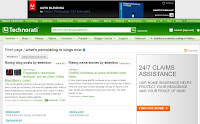
Technorati is a blog search engine. It can help me find information appearing on blogs. For being a beginner, I can check what the popular topics and most linked blogs are from their top 100 blogs. Also, I can collect a list of my favorite blogs and keep track on them.

But I think Technorati is more beneficial if you are a blogger and want to make your blog more visible. Especially if someone is making a living on blogging or enterprise blogs, Technorati would be definitely useful for them.

It seems that Technoratic can help blog owners to find out who is linking to their blogs, no matter what blogging platforms they use. It also offers some useful features, such as tagging (I know some blog platforms do not allow multiple tags) and ping, which notice and update Technoratic that there is new content on the blog.

Second, building authority is important for bloggers, because that the higher numbers means the more blogs linking to your blog. Technorati Authority measures the number of blogs, rather than the number of links. So if a blog owner writes some things that are interesting or important that many other blogs link to there, that blog would have a high authority number and it may shows on Technorati Rank.

Right now I’ve just sign up, claimed my blog, and added the Technorati logo on my blog. But I think I just need it to check any update from my favorite blogs, and perhaps someday I will need it to manage my blog if I’ll start to write something that I want more people to read.

There are two resources about Technorati.
This is from Gina Chen, who talked about why journalist bloggers should use it.
This one is about A Beginner’s guide to Technorati.

Friday, July 24, 2009

Week 3 Participation

What I did for Week 3:
  • Finish my produsage assignment
  • Post at least 3 posts my own blog
  • Participated on the discussion board
  • Read the Bruns chapters
  • Got myself familiar with Searchme.com
  • Read and commented on classmates' blogs
  • Briefly looked at classmates' posted produsage assignments